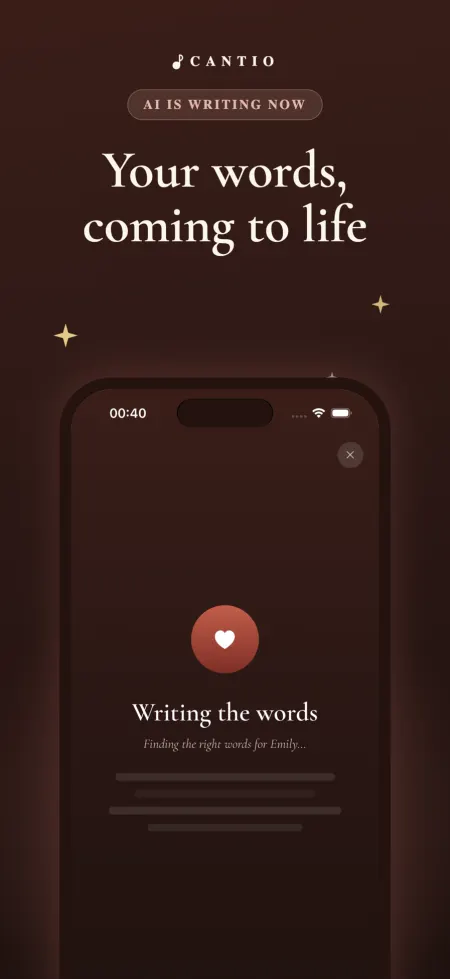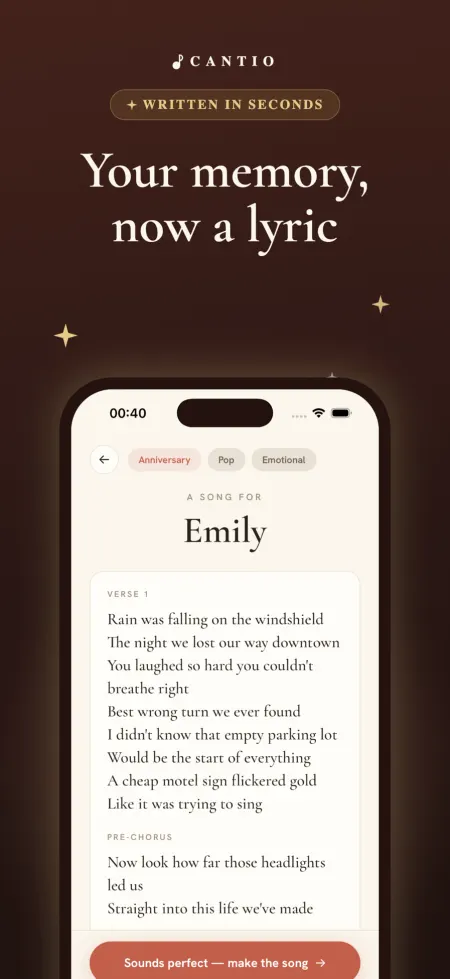
Most anniversary songs are love songs with a date attached. They could be played at any point in any relationship, which is the problem: the anniversary is the deadline, not the subject. What makes one of these land is that it could only be about this particular year, with this particular person, and that it says something the card in the drawer never did.
Pick a Tuesday, not the wedding day
The big days are already photographed, retold and agreed upon. There is nothing left in them to discover, and a song that walks through the ceremony is a slideshow with a melody.
The ordinary day is where the material is. The winter you both had the flu and watched the same series twice. The drive where the heating broke. The flat with the terrible kitchen you now talk about fondly and hated at the time. Those days are the relationship — the wedding was the announcement of it.
What the number of years actually changes
A first anniversary is about becoming: you are still finding out what the two of you are, and the song can admit that without being less romantic for it. A tenth is about proof — you have the evidence now, and the song gets to cite it. A twenty-fifth is usually about the people you were, and the distance between them and the people in the room.
Knowing which of those you are writing saves you from the generic middle where every anniversary song lives. Write the year you are in, not the idea of an anniversary.
Do not try to replace "our song"
If you already have one, it is not competing with anything you make, and trying to displace it is the fastest way for a good idea to feel awkward. Yours has a different job: theirs was chosen, this one was written. Say so inside the song if it helps — a line that nods to the first song is warmer than a song pretending to be it.
The genre is the year you met
When you have no idea what style to pick, the music you were both around when you met is almost always right, and it does something no lyric can: it puts the listener back there before the first line arrives. Failing that, pick the music they play when nobody is asking — not the music you would like to be the kind of couple who plays.
Say it to them, not about them
Anniversary writing drifts into the third person — a summary of a shared history, addressed to nobody. Keep it in the second. You are talking to one person who will be standing in the kitchen when it plays, and the difference between "we built a life" and "you left the light on in the hall again" is the difference between a toast and a song.
The thing you have never actually said
Every long relationship has one: the thank-you that never came up, the apology that stopped being urgent, the moment you decided without telling them. A song is one of the few formats where that can be said without making an occasion of it. If you have one of those, it is the song, and everything else in this list is optional.
Put it in the language they think in
If you and your person do not share a first language, the song should be in theirs. A sentence that has to be translated in their head arrives a beat late, and the whole point of this is arriving on time.
Making one
Cantio has anniversaries as one of the occasions it writes for: you give their name, your relationship, the occasion and the one detail you picked at the top of this page, and it writes original lyrics around them rather than around the word anniversary. The words arrive before any music does, so the Tuesday you chose can be checked, and any line changed, before a note is recorded.
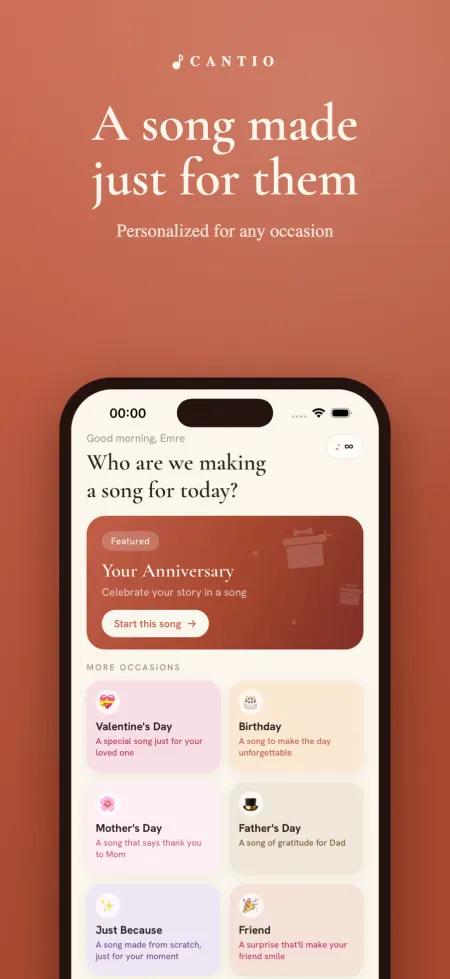
It writes and sings in 11 languages, which is the practical end of the point about the language they think in, and every story comes back as two different songs — so the last decision is still yours, and it is the one about which of the two sounds like the pair of you. The four-step guide covers the rest, and how to write lyrics about someone goes deeper on choosing the detail.
One check before you send it
Ask whether you could have sent this same song last year. If you could, it is about the relationship in general, and the relationship in general is not what either of you is marking today. The fix is one line: something that happened since the last one of these.
That is also what makes these worth keeping. A song written for the eighth year is a record of the eighth year, and in a decade the two of you will have a row of them that say what each year was actually like — which no card in a drawer has ever managed.