Two questions travel under this one, and merging them is why the answers people give each other contradict one another. The first is whether anyone owns an AI-generated song. The second is whether you are allowed to use it. They have different answers, and the second is not settled by copyright law at all. This post is about the first.
The short answer, and where it applies
In the United States, a song produced entirely by a generative model from a prompt is not protected by copyright, because as far as the law is concerned nobody wrote it. That is not a gap waiting to be closed. It follows from a requirement that predates any of this: a copyrightable work has to have a human author.
Everything below is United States law, from the US Copyright Office and the federal courts. Other countries have answered the same question differently. If you are somewhere else, treat this as background rather than as your answer, and read what your own copyright office has published. It is also not legal advice — it is a summary of what the published sources say, with links so you can read them yourself.
What the Copyright Office said about prompts
The clearest statement is in the Office's 2023 registration guidance, and it turns on who decides what the work looks like. Prompts, it says, "function more like instructions to a commissioned artist — they identify what the prompter wishes to have depicted, but the machine determines how those instructions are implemented in its output."
That analogy does a lot of work. Commissioning a painting does not make you the painter, however precise the brief. You can describe a song in four sentences of real detail and still not be the one who chose the chord under the second line. The Office returned to this in Part 2 of its report on copyright and AI, published in January 2025: generative outputs can be protected "only where a human author has determined sufficient expressive elements", and not through "the mere provision of prompts".
The courts reached the same place
In Thaler v. Perlmutter, an applicant listed an AI system as the sole author of an image. The D.C. Circuit held in March 2025 that the Copyright Act requires a human author, and the registration was properly refused. The Supreme Court declined to take the case in March 2026, so that holding stands.
Read what it actually decided, though. It was about a work claimed to have been made by a machine on its own, with the machine named as author. It did not hold that a work is unprotectable because AI was involved in making it. That is a different question, and it is the one you are in.
Where the line actually sits
The useful question is never "did a machine touch this". It is what a person contributed, and whether that contribution is itself expressive. The 2023 guidance gives two ways a human contribution can carry the day: a person "may select or arrange AI-generated material in a sufficiently creative way that the resulting work as a whole constitutes an original work of authorship", and an artist "may modify material originally generated by AI technology to such a degree that the modifications meet the standard for copyright protection".
Part 2 adds the reassuring half of this: using AI to assist in making something, or putting AI-generated material inside a larger human-made work, "does not bar copyrightability". A song is not disqualified by having been produced with a tool. It is only unprotected to the extent that no person authored it.
So what about the song you made this afternoon
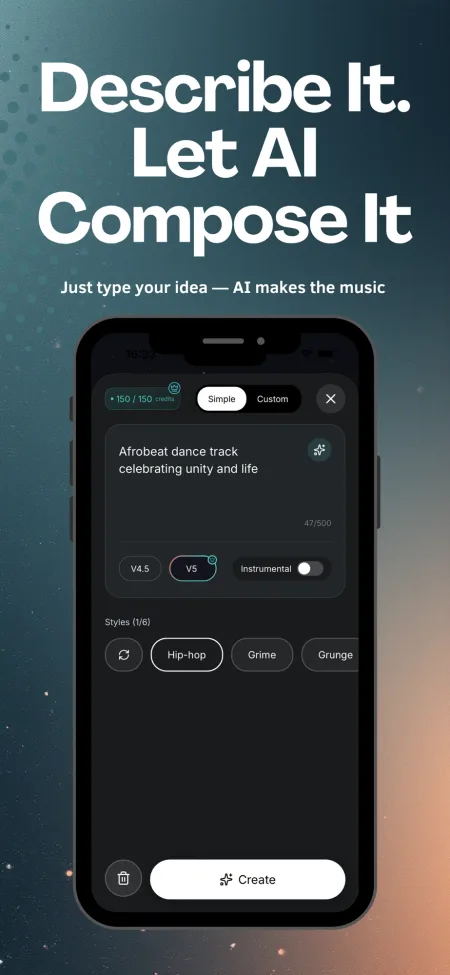
You typed one sentence and kept what came back. There is very little here the Office would call yours. The sentence was an instruction; the machine decided the rest.
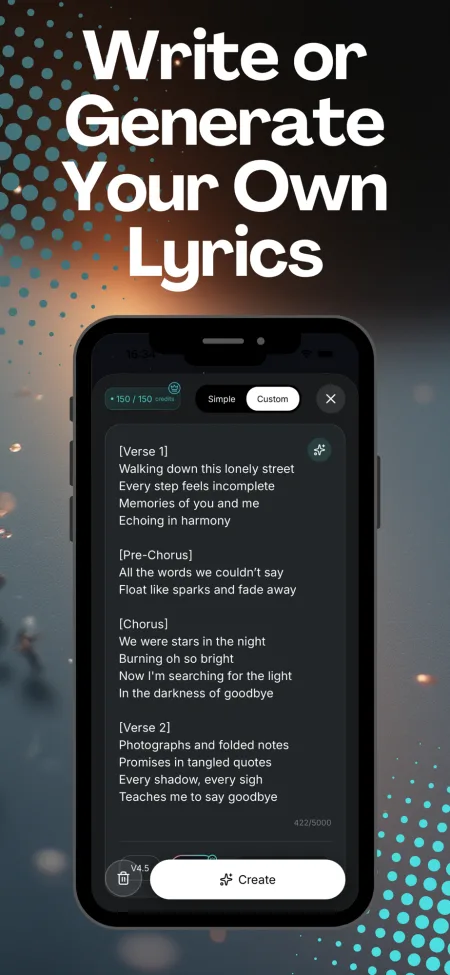
You wrote the lyrics and had them performed. The lyrics are a human-authored work, and they do not stop being one because they arrived in a track. What that gets you is protection for the words, not for everything around them.
You generated, then rewrote it line by line, cut two sections and re-ordered the rest. Now you are in the territory the guidance describes as selection, arrangement and modification, and whether it clears the bar depends on how much of the result is your choices rather than the model's.
If you ever register one, you have to say so
This is the part people miss, and it is not optional. Applicants "have a duty to disclose the inclusion of AI-generated content in a work submitted for registration and to provide a brief explanation of the human author's contributions", and AI-generated content that is more than de minimis "should be explicitly excluded from the application". You register what you did, and you carve out what you did not. A registration obtained by staying quiet about the tool is a registration with a problem in it.
The other question, which is the one people actually mean
Most people asking whether AI music is copyrighted are not asking about registration. They are asking whether they can put the track in something and not get a letter. That is governed by the terms of whichever tool made it, not by copyright law, and it has its own answer. For HyperMusic AI, the Terms grant AI Creations to you for personal and commercial use, subject to copyright law and third-party rights — and say plainly that generated music is not guaranteed to be unique. Read the equivalent page for any tool before you build something around a track.
What is left when the law is done
The part copyright is interested in turns out to be the part you contributed: what the song is about, which lines stayed, what got cut. That is also the part that decides whether anyone wants to hear it twice. The overlap is not a coincidence — both are asking the same question about who actually made the thing.